The Gender Pay Gap: What’s Changing and What Isn’t
 Mar, 12 2026
Women still earn about 82 cents for every dollar men make in the U.S. That’s not a typo. It’s 2026, and the numbers haven’t moved much in over a decade. The gap is even wider for Black, Latina, and Indigenous women - they make 68 cents and 60 cents on the dollar, respectively. Meanwhile, Asian women earn closer to 90 cents, but that average hides deep divides within the group. The story isn’t just about paychecks. It’s about power, access, and who gets to speak up without fear of backlash.
Where the Gap Is Narrowing
Some progress is real, even if it’s slow. In 2024, the U.S. Bureau of Labor Statistics found that women under 35 now earn 94% of what men their age make. That’s a big jump from just 79% in 2000. Why? More women are entering high-paying fields like engineering, data science, and cybersecurity. Companies like Salesforce and Microsoft have publicly disclosed their pay data since 2018, and they’ve spent millions fixing internal gaps. Salesforce alone paid out over $10 million in salary adjustments between 2015 and 2023 to close its gender pay gap.
Unionized workplaces also show better results. According to the Economic Policy Institute, women in unions earn 96% of what male union members make - compared to 81% in non-union jobs. Collective bargaining matters. When pay scales are transparent and negotiated, bias has less room to hide.
Parental leave policies are helping too. States like California and New Jersey now offer up to 12 weeks of paid leave for all parents, not just mothers. More companies are letting dads take time off without stigma. That shifts the whole dynamic - if both parents are expected to care for kids, neither is automatically pushed into lower-paying, part-time roles.
Where the Gap Is Still Wide - and Getting Worse
But here’s the uncomfortable truth: the progress we see is mostly among young, college-educated women in urban tech hubs. For the rest? Not so much.
Take retail, hospitality, and caregiving - jobs where over 70% of workers are women. The median wage in these fields? Under $15 an hour. And they’ve barely budged since 2010. Meanwhile, CEO pay has exploded. The average CEO now makes 344 times what a typical worker earns. That gap doesn’t care about gender - but it hurts women more, because they’re overrepresented in the low-wage brackets.
Remote work was supposed to help. But a 2025 Harvard study found that women in hybrid roles are 30% less likely to be promoted than men in the same setup. Why? Managers still favor people they see in person - and women are more likely to work from home to manage childcare or elder care. That’s not a policy failure. It’s a cultural one.
And then there’s the motherhood penalty. Every child a woman has reduces her lifetime earnings by an average of 4%. Men? Their earnings go up by 6%. That’s not a coincidence. It’s baked into hiring, promotion, and performance review systems. A 2024 study from Stanford showed that when identical resumes were sent out - one with “PTA member” listed, one without - the woman with the PTA role was 40% less likely to be called back.

What’s Not Being Said
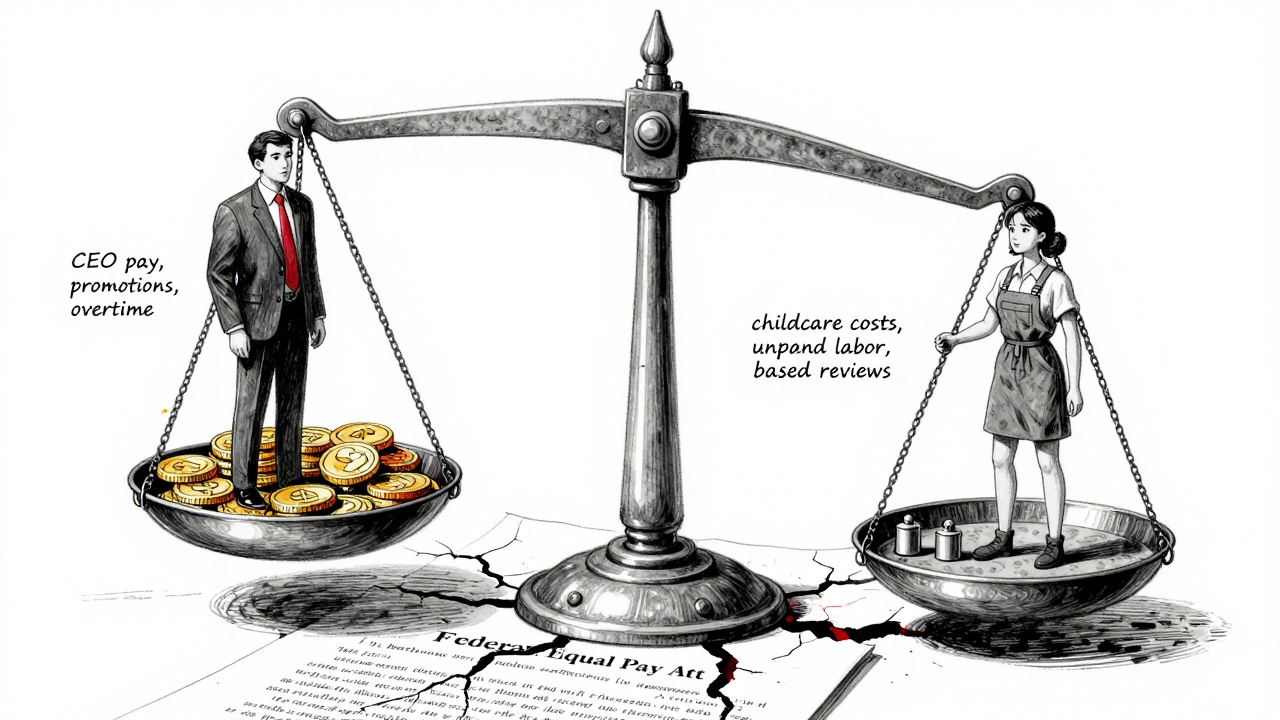
Most discussions about the pay gap focus on salary. But what about bonuses? Stock options? Overtime? Commission structures? Women are far less likely to negotiate raises - not because they’re shy, but because they’ve been punished for it.
A 2023 survey of 12,000 professionals found that women who asked for raises were 20% more likely to be labeled “difficult” than men who asked the same way. Managers reported feeling “uncomfortable” when women pushed back on pay offers. That’s not about confidence. It’s about gendered expectations.
And let’s not forget the hidden costs: childcare, transportation, healthcare. A single mom working two jobs in rural Ohio might make $32,000 a year - but after paying $1,200 a month for daycare, she’s left with less than minimum wage. No one talks about that when they say “women earn less.”
What’s Actually Working
Some places are fixing this - not with speeches, but with systems.
Germany passed a law in 2017 requiring companies with over 200 employees to disclose pay data upon request. Result? The gender pay gap dropped 7% in three years. Iceland went further: since 2018, companies must prove they pay men and women equally or face fines. Over 90% of employers with more than 25 workers are now certified as equal pay compliant.
In the U.S., states like Colorado and Washington require employers to list salary ranges in job postings. Since 2021, applicants in those states have seen a 15% increase in starting offers for women compared to before the law. That’s not luck. That’s transparency working.
And it’s not just government. Organizations like Lean In and Catalyst are training managers to recognize bias in performance reviews. One tech firm in Austin changed its review form to remove subjective phrases like “has leadership potential” and replaced them with measurable outcomes. Within a year, promotions for women jumped 22%.
What’s Still Broken
Here’s the kicker: most companies still don’t have to do any of this. The federal Equal Pay Act of 1963 doesn’t require audits, disclosures, or penalties. It just says “don’t be overtly sexist.” That’s like saying “don’t steal” without installing security cameras.
Women of color face double discrimination - and most pay equity tools don’t even track race. A Latina woman in a Fortune 500 company might be paid the same as her white female colleague - but still $20,000 less than her white male peer. That’s invisible in aggregate data.
And then there’s the gig economy. Uber, DoorDash, TaskRabbit - these platforms claim to be “gender-neutral.” But a 2025 MIT study found that women drivers earn 7% less than men, even after controlling for hours, location, and time of day. Why? Algorithms assign rides based on past behavior - and women are more likely to accept lower-paying short trips because they’re juggling kids or care work. The system doesn’t punish bias. It automates it.
What You Can Do - Right Now
You don’t need to be a CEO to make a difference.
- If you’re hiring: Always list salary ranges. It’s legal in 12 states - and it levels the playing field.
- If you’re a manager: Review promotion decisions with data. Ask: Who got the high-profile projects? Who got mentorship? Who got overlooked?
- If you’re an employee: Know your worth. Use sites like Levels.fyi or PayScale to compare salaries in your role. Don’t wait for an annual review - ask for a conversation.
- If you’re a parent: Share the load. If you’re a man, take paternity leave. If you’re a woman, push back on being the default caregiver. Your career depends on it.
The gender pay gap isn’t a mystery. It’s a system. And systems can be changed - if enough people refuse to accept the status quo.
Why hasn’t the gender pay gap closed yet?
It hasn’t closed because many of the causes aren’t about individual choices - they’re built into workplace systems. Hiring practices, promotion criteria, performance reviews, and even software algorithms often favor men without anyone realizing it. Pay secrecy, lack of parental leave for fathers, and the assumption that women will prioritize family over career all add up. Change requires systemic fixes - not just awareness.
Do equal pay laws actually work?
Yes - but only when they’re enforced. Laws like Iceland’s equal pay certification or Colorado’s salary transparency rule have led to measurable drops in the gap. But federal laws in the U.S. are weak. The Equal Pay Act doesn’t require audits, disclosures, or penalties. Companies aren’t forced to fix what they’re not required to see.
Is the pay gap the same for all women?
No. White women earn about 82 cents on the dollar compared to white men. Black women earn 68 cents, Latina women 60 cents, and Indigenous women 57 cents. Asian women average 90 cents, but that number hides extreme differences - for example, Bangladeshi and Pakistani women earn closer to 70 cents. Race, immigration status, and geography all shape the gap.
Does having kids really hurt women’s pay?
Yes - and it doesn’t hurt men. Research shows that each child reduces a woman’s lifetime earnings by about 4%, while men see a 6% increase. This isn’t about time off - it’s about perception. Employers assume women will leave jobs or reduce hours after having kids. Men are seen as more committed. That bias shows up in hiring, promotions, and raises.
Can remote work help close the gap?
It can - but it often makes things worse. A 2025 Harvard study found women in hybrid roles are 30% less likely to be promoted than men in the same setup. Why? Managers still promote people they see in person. Women are more likely to work remotely to manage caregiving. Without intentional policies, remote work reinforces old biases instead of breaking them.