Splurge vs. Save: Which Women’s Beauty Products Are Actually Worth the Money
 Feb, 24 2026
Let’s be real: the beauty aisle is a minefield. One day you’re convinced that a $200 serum is going to transform your skin, and the next you’re scrolling through TikTok tutorials showing a $12 moisturizer doing the same job. So which beauty products actually deserve your hard-earned cash? And which ones are just fancy packaging with empty promises?
Why Some Products Cost More
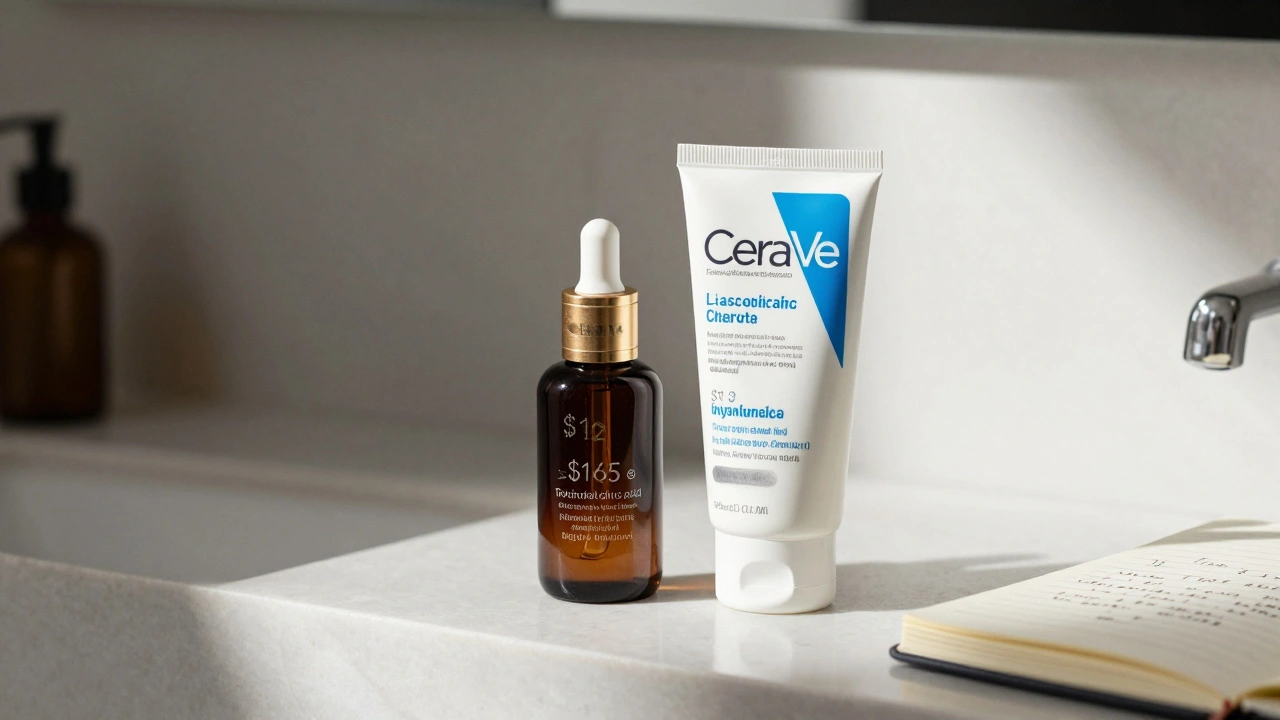
Not all high-priced skincare is a scam. Some brands charge more because they use rare, clinically tested ingredients-like stabilized vitamin C at 20% concentration, or peptides backed by peer-reviewed studies. A 2023 clinical trial published in the Journal of Clinical and Aesthetic Dermatology found that serums with 15% L-ascorbic acid, 1% hyaluronic acid, and 0.5% ferulic acid improved skin elasticity by 34% over 12 weeks. That exact formula? It’s in a $165 serum from a luxury brand. But here’s the catch: you can’t buy that exact combination at a drugstore because those ingredients are unstable and expensive to formulate properly.
On the flip side, a lot of premium products charge for branding, packaging, and celebrity endorsements-not science. A $120 face cream might contain the same base as a $15 one: water, glycerin, dimethicone. The difference? A gold-plated dropper and a fancy scent.
Where to Splurge: The Non-Negotiables
There are three areas where spending more makes a real difference: sunscreen, retinoids, and vitamin C serums.
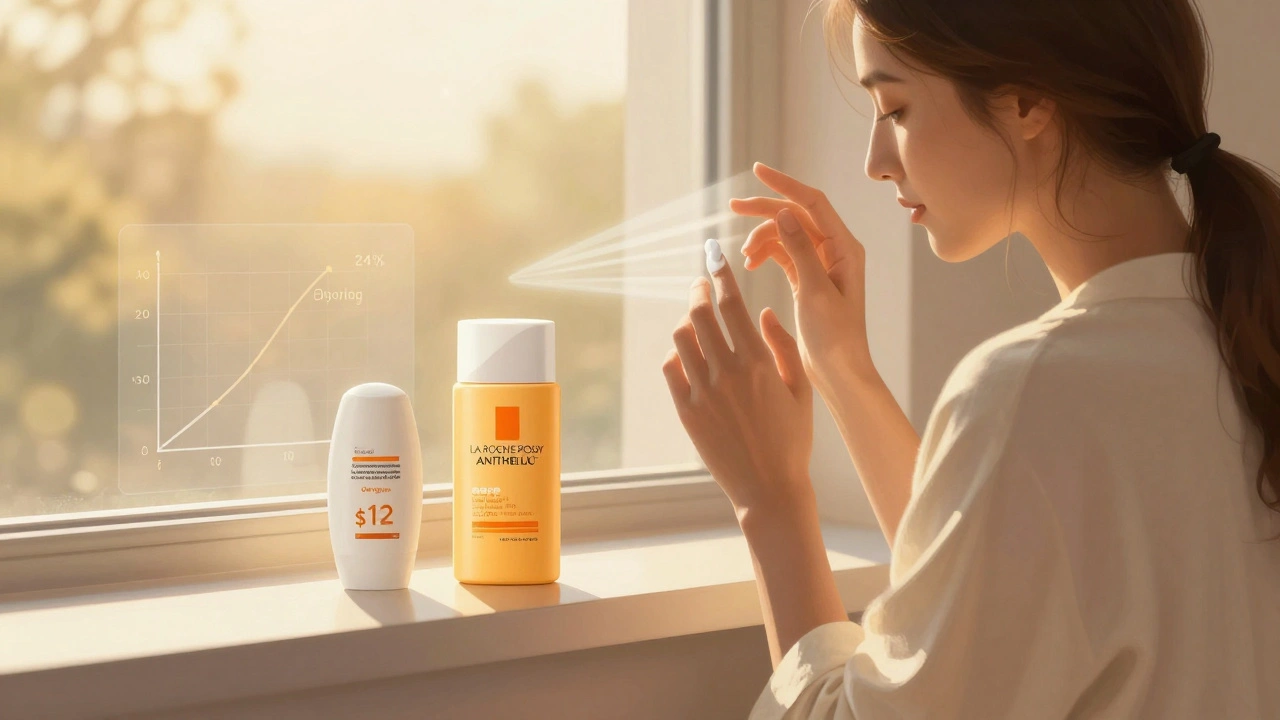
Sunscreen isn’t just about preventing sunburn. It’s about stopping photoaging, dark spots, and skin cancer. A 2024 study from the American Academy of Dermatology showed that daily sunscreen use reduced visible signs of aging by 24% over four years. But not all sunscreens are created equal. Look for broad-spectrum SPF 30 or higher with zinc oxide or titanium dioxide as active ingredients. Drugstore sunscreens often feel greasy, leave a white cast, or irritate sensitive skin. A $35 sunscreen like EltaMD UV Clear or La Roche-Posay Anthelios doesn’t just protect-it feels like a luxury. You’ll actually wear it every day.
Retinoids are the gold standard for anti-aging and acne. Prescription tretinoin (0.025%-0.1%) is proven to thicken skin, fade discoloration, and boost collagen. Over-the-counter retinol is weaker, but a well-formulated 1% retinol serum from a reputable brand like SkinCeuticals or Paula’s Choice delivers noticeable results. Cheap retinol? It’s often unstable, poorly packaged, or diluted. You’ll waste money and time if you go with a $12 version that degrades in light and doesn’t penetrate deeply enough.
Vitamin C is another area where quality matters. L-ascorbic acid oxidizes fast. If the bottle isn’t airless and dark, or if the concentration is below 10%, it’s useless. A $60 serum with 15% L-ascorbic acid, 1% hyaluronic acid, and 0.5% ferulic acid (like SkinCeuticals C E Ferulic) is the benchmark. It’s not just a trend-it’s science.
Where to Save: The Surprising Bargains
Here’s where you can save big without sacrificing results:
- Cleansers-Your face doesn’t need fancy ingredients. A gentle, pH-balanced cleanser with ceramides or niacinamide is all you need. CeraVe Hydrating Cleanser ($12) and Vanicream Gentle Facial Cleanser ($11) are dermatologist favorites. They clean without stripping your barrier. No need to spend $40 on a “luxury” foaming cleanser with rose extract.
- Moisturizers-The best moisturizers are simple. Look for ceramides, hyaluronic acid, and squalane. CeraVe Moisturizing Cream ($16) has the same ceramide blend as $80 creams. It’s thicker, lasts longer, and works just as well. Even Neutrogena Hydro Boost Water Gel ($18) is packed with hyaluronic acid and feels amazing.
- Sheet masks-They’re fun, but not essential. A $2 sheet mask from The Face Shop or Innisfree delivers the same hydration as a $12 one. The difference? Scent and packaging. Your skin doesn’t care.
- Eye creams-This is one of the biggest marketing traps. Your eye area is thin, yes, but it doesn’t need a special formula. A good moisturizer works just fine. Applying your $16 CeraVe cream around your eyes saves you $50 a month. No magic peptides required.
The Middle Ground: Sometimes It’s Worth It
Some products sit in the gray zone. You don’t need to splurge, but you might want to.
Exfoliants: Chemical exfoliants like AHAs and BHAs can be hit or miss. A $20 The Ordinary Glycolic Acid Toner works fine for most. But if you have sensitive skin, a $35 Paula’s Choice 2% BHA Liquid Exfoliant is gentler and more effective because it’s buffered with soothing ingredients. It’s not a luxury-it’s a smart upgrade.
Facial oils: Jojoba oil ($10) is chemically similar to your skin’s natural sebum. It’s a perfect substitute for $60 argan or rosehip oils. But if you’re looking for something with active botanicals-like bakuchiol (a natural retinol alternative)-then a $45 oil like Biossance Squalane + Rose can be worth it. It’s not just oil; it’s a treatment.
What’s Never Worth It
Some categories are just not worth the hype:
- LED masks: Home devices like the Project E Beauty mask ($200) claim to boost collagen. But clinical studies show you’d need 20+ minutes of consistent, high-intensity light exposure-something most home devices can’t deliver. Save your money. Professional treatments work better, but even those aren’t magic.
- Beauty devices: Gua sha, jade rollers, microcurrent tools-they feel nice, but they don’t change skin structure. No peer-reviewed study proves they reduce wrinkles or tighten skin long-term.
- “Detox” or “purifying” masks: Your liver and kidneys detox your body. Your skin doesn’t need a clay mask to “pull out toxins.” Charcoal masks are just clay with charcoal added for marketing. They dry out your skin. Skip them.
How to Build a Smart Routine
Here’s a simple, science-backed routine that works whether you’re on a budget or willing to splurge:
- Morning: Cleanse → Vitamin C serum (splurge) → Moisturizer (save) → Sunscreen (splurge)
- Night: Cleanse → Retinoid (splurge) → Moisturizer (save)
- Twice a week: Gentle exfoliant (choose based on skin sensitivity)
That’s it. No 10-step routines. No unnecessary layers. Just three core products that do real work-and two that you can buy for under $20.
Final Rule: Test Before You Buy
Never buy full-size products without testing first. Most brands offer samples. Use them. Your skin reacts differently than someone else’s. A serum that works for your friend might break you out. A moisturizer that feels heavenly on one person might clog pores on another.
Buy travel sizes. Ask for samples at Sephora or Ulta. Order from retailers with free returns. You’re not being cheap-you’re being smart.
Beauty isn’t about how much you spend. It’s about what works for your skin, your lifestyle, and your budget. The best product isn’t the most expensive one. It’s the one you’ll use every day-and the one that actually delivers results.
Are expensive skincare products always better than drugstore ones?
No. Expensive skincare isn’t always better. The most important ingredients-like retinoids, vitamin C, and sunscreen-need the right formulation, concentration, and stability. Luxury brands often get this right, but some drugstore products do too. For example, CeraVe and The Ordinary offer science-backed formulas at a fraction of the price. What matters is the ingredient list, not the price tag.
Can I use the same moisturizer for my face and body?
Technically, yes-but it’s not ideal. Facial skin is thinner and more sensitive than body skin. Facial moisturizers are designed to be lightweight and non-comedogenic. Body creams are thicker and may clog pores if used on your face. But if you’re on a tight budget, a simple, fragrance-free moisturizer like CeraVe Moisturizing Cream works well for both. Just avoid heavy occlusives like petroleum jelly on your face.
Do I really need a separate eye cream?
No. The skin around your eyes is thinner, but it doesn’t require special ingredients. Most eye creams are just moisturizers with added marketing claims like "reduces wrinkles" or "brightens dark circles." A good facial moisturizer applied gently around the eyes works just as well. Save your money unless you have a specific concern like puffiness, where caffeine-containing products might help.
Is it worth buying organic or natural skincare?
Not necessarily. "Natural" and "organic" are marketing terms, not regulated standards in skincare. Many natural ingredients can irritate skin-like essential oils, citrus extracts, or plant-based acids. On the flip side, synthetic ingredients like hyaluronic acid and niacinamide are lab-made but proven safe and effective. Focus on ingredient function, not labels. A $10 serum with niacinamide is more effective than a $50 "natural" cream with no active ingredients.
How long should I wait to see results from a new skincare product?
It depends on the product. Retinoids and vitamin C usually take 6-12 weeks to show visible changes. Sunscreen works immediately (protection), but anti-aging benefits take months. Moisturizers hydrate right away, but barrier repair can take 4-6 weeks. Don’t quit after two weeks. Give it at least 8 weeks, and track changes with photos. Consistency beats intensity every time.