Seasonal Affective Disorder in Women: Light, Sleep, and Routine
 Jan, 29 2026
Every year, as the days get shorter and the sun disappears earlier, some women start feeling off-not just tired, but heavy. Sad. Empty. Like they’re dragging through life in slow motion. It’s not laziness. It’s not just winter blues. For many women, this is Seasonal Affective Disorder, or SAD. And it hits harder, more often, and with more intensity than most people realize.
Why Women Are More Affected
Women are four times more likely than men to be diagnosed with SAD. That’s not a coincidence. It’s biology. Hormones play a big role. Estrogen and serotonin are deeply linked. When daylight fades in fall and winter, serotonin levels drop. For women, that drop hits harder because estrogen naturally helps regulate serotonin. When estrogen dips-like during the luteal phase of the menstrual cycle, after childbirth, or during perimenopause-the brain’s ability to stay balanced weakens. Add in lower vitamin D from less sun exposure, and you’ve got a perfect storm.
Research from the National Institute of Mental Health shows that over 60% of women with SAD report worsening symptoms right before their period. That’s not just PMS. It’s SAD overlapping with hormonal shifts. And it’s often mislabeled as stress or burnout.
The Light Connection
Light isn’t just about seeing. It’s about signaling. Your brain uses sunlight to tell your body what time it is. When you don’t get enough natural light-especially in the morning-your internal clock gets confused. That throws off melatonin, cortisol, and serotonin. Melatonin stays high too long, making you feel sleepy during the day. Cortisol, your energy hormone, doesn’t spike properly, leaving you sluggish. Serotonin crashes, and mood follows.
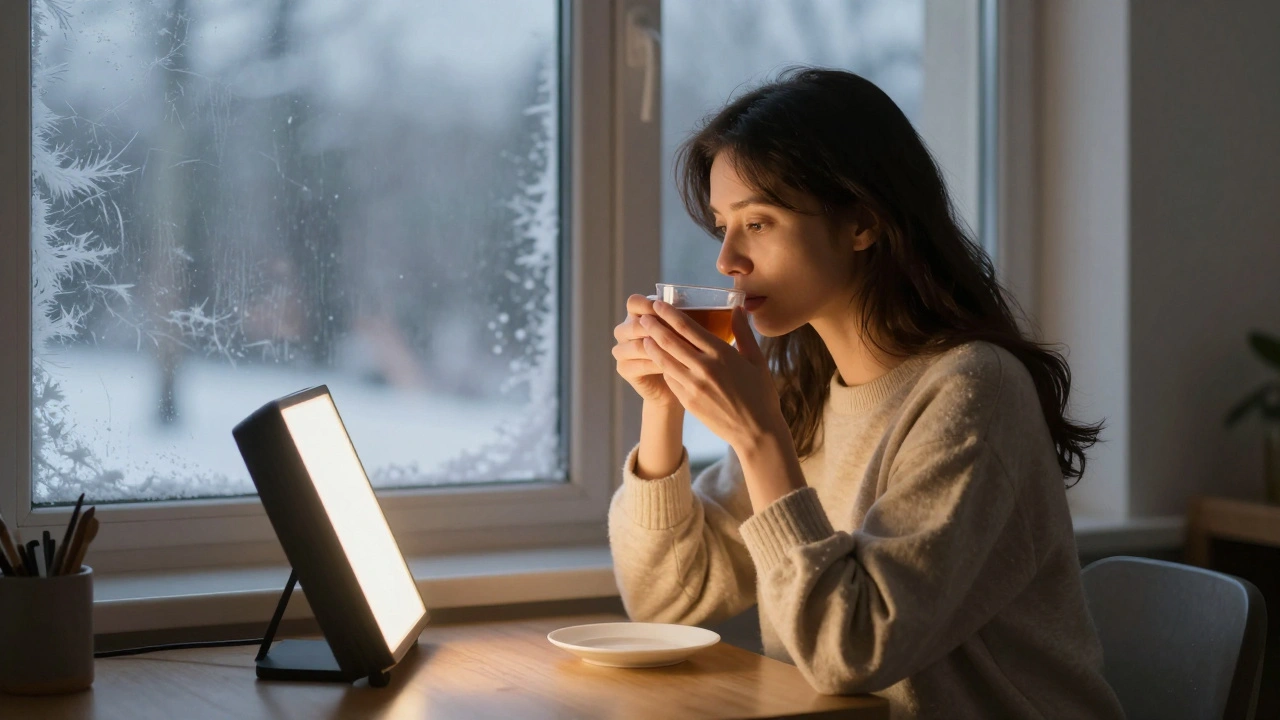
Light therapy isn’t a gimmick. It’s science. A 2023 study in the Journal of Affective Disorders found that women who used a 10,000-lux light box for 30 minutes each morning saw a 60% reduction in SAD symptoms within two weeks. The key? Timing. Using it between 6:30 and 8:30 a.m. mimics natural sunrise. Sitting near a window won’t cut it. Indoors, even on a bright day, you’re getting less than 500 lux. Outside on a sunny day? You’re getting 10,000 to 50,000 lux. That’s the gap.
Not all light boxes are equal. Look for ones that emit 10,000 lux, filter out UV rays, and have a wide viewing angle. Avoid blue-light-only lamps. They may feel intense, but they don’t replicate full-spectrum daylight the way your brain needs.
Sleep Isn’t Just About Hours
Women with SAD don’t just sleep less. They sleep poorly. Deep sleep drops. REM sleep gets disrupted. And many end up sleeping longer-not because they’re rested, but because their body is trying to compensate.
One study tracking 400 women with SAD found that 78% reported sleeping more than 9 hours a day during winter. Yet they still felt exhausted. Why? Their sleep architecture broke down. Their bodies weren’t cycling through restorative stages properly. The fix? Not more sleep. Better timing.
Try this: Go to bed and wake up at the same time every day-even on weekends. No exceptions. Your circadian rhythm thrives on predictability. If you’re sleeping in until noon on Saturday, you’re resetting your internal clock backward. That makes Monday morning even harder.
Also, ditch screens an hour before bed. Blue light from phones and laptops suppresses melatonin even more than dim lighting. Swap scrolling for reading a physical book, taking a warm shower, or listening to calm music. Small changes add up.

Routine: The Silent Hero
When you’re low on energy, routine feels impossible. But routine is what keeps you from sinking. It’s not about being productive. It’s about structure. Structure gives your brain a sense of control when everything else feels out of sync.
Here’s what works for women who’ve pulled out of SAD:
- Morning light within 30 minutes of waking-even if it’s cloudy, sit by a window or step outside.
- Move your body daily-even a 15-minute walk. Movement boosts serotonin and breaks the cycle of inactivity.
- Eat protein early-breakfast with eggs, Greek yogurt, or tofu helps stabilize blood sugar and mood.
- Plan one small win each day-water a plant, call a friend, organize one drawer. Achievement, no matter how small, triggers dopamine.
- Limit sugar and refined carbs-they give a quick mood lift, then a crash. That crash hits harder in winter.
Women who stick to this kind of routine for three weeks report feeling like themselves again. Not perfectly. But better. Enough to get through the dark months without feeling trapped.
What Doesn’t Work
Let’s clear up some myths.
“Just be positive.” No. SAD isn’t a mindset. It’s a neurochemical shift. Telling someone to “cheer up” is like telling someone with a broken leg to “walk it off.”
“Vitamin D supplements alone will fix it.” They help-but not enough. A 2024 meta-analysis found that while vitamin D improved mood slightly, it didn’t reduce SAD symptoms on its own. It needs to work with light and routine.
“I’ll wait until spring.” Waiting makes it worse. The longer your brain stays in low-serotonin mode, the harder it is to bounce back. Early intervention is critical.

When to Seek Help
If your symptoms last more than two weeks, interfere with work or relationships, or include thoughts of hopelessness or self-harm-you need professional support. Therapy, especially cognitive behavioral therapy adapted for SAD (CBT-SAD), has been shown to be as effective as light therapy in long-term studies. Some women benefit from a combination of both.
Antidepressants aren’t always needed, but for women with severe SAD, SSRIs taken in early fall can prevent symptoms before they start. Talk to your doctor. There’s no shame in needing more than sunlight.
Real-Life Example
Maria, 38, a teacher in Minnesota, used to dread November. She’d cancel plans, sleep 11 hours a day, and cry for no reason. She thought she was just “too busy.” Then she tried the routine: light box at 7 a.m., daily walk after work, fixed bedtime at 10:30 p.m., no screens after 9. Within 17 days, she woke up without dread. She started teaching again with energy. Not because she “got over it.” Because she gave her brain what it needed.
She didn’t need a miracle. She needed structure. Light. Sleep. Routine.
What to Do This Week
You don’t need to overhaul your life. Start with one thing.
- Buy or borrow a 10,000-lux light box. Use it for 30 minutes right after waking up.
- Set your alarm and wake-up time for the next seven days. No snoozing. No exceptions.
- Take a 10-minute walk outside before noon-even if it’s cold.
- Write down one thing you did well each day. No matter how small.
Do those four things for a week. See what changes. Not because it’s magic. Because your brain is wired to respond to rhythm, light, and consistency. You’re not broken. You’re out of sync. And sync is repairable.
Is seasonal affective disorder the same as depression?
SAD is a type of depression, but it follows a seasonal pattern. It typically starts in fall or winter and lifts in spring or summer. Unlike major depression, which can last year-round, SAD symptoms improve with more daylight and consistent routines. The same treatments-light therapy, therapy, and lifestyle changes-work for both, but timing and triggers differ.
Can light therapy cause eye damage?
No, if you use a properly designed light box. Reputable devices filter out harmful UV rays and emit safe levels of visible light. Avoid tanning beds or bright white lamps not meant for SAD. Stick to FDA-cleared light therapy devices. If you have eye conditions like glaucoma or retinal disease, talk to your doctor before starting.
Why does SAD get worse around my period?
Estrogen drops sharply in the days before your period, and estrogen helps regulate serotonin. When daylight is already low in winter, this double hit on serotonin can trigger severe mood dips. Many women with SAD notice their worst symptoms occur in late October through November, right before menstruation. Tracking symptoms with a journal can help identify this pattern and guide treatment.
Do I need to use a light box forever?
Not necessarily. Many women use light therapy only during fall and winter. Once spring arrives and daylight increases naturally, they can stop. Some continue using it occasionally if they feel symptoms creeping back. The goal isn’t lifelong dependence-it’s restoring your body’s natural rhythm so you can thrive without it.
Can diet help with SAD?
Yes, but not as a cure. Foods rich in omega-3s (like salmon, flaxseeds), vitamin D (fortified milk, egg yolks), and complex carbs (oats, sweet potatoes) can support brain chemistry. Avoid sugary snacks-they cause energy spikes and crashes that worsen mood swings. A balanced diet helps, but it works best alongside light, sleep, and movement.