Restlessness During Meditation: Women’s Practical Strategies to Settle
 Jan, 5 2026
Ever sit down to meditate, only to feel like your body’s on fire and your mind’s running a marathon? You’re not broken. You’re not failing. And you’re definitely not alone. For many women, restlessness during meditation isn’t a sign of poor discipline-it’s a normal response to stress, hormonal shifts, and the constant mental load so many carry daily. The good news? There are real, simple ways to settle into stillness-even when your body screams to move and your thoughts refuse to quiet down.
Why Restlessness Hits Harder for Women
Women often experience restlessness during meditation for reasons that go beyond "just being distracted." Hormonal fluctuations, especially around menstruation, perimenopause, or postpartum, can spike cortisol and norepinephrine levels, making the nervous system feel like it’s stuck in high gear. Add in societal pressures-juggling work, caregiving, emotional labor-and your brain never gets a real break. Meditation doesn’t fix this overnight. But it can help you learn to sit with the chaos instead of fighting it.A 2023 study from the University of California, San Francisco tracked 1,200 women practicing daily mindfulness over six months. Those who reported high levels of daily stress saw a 40% reduction in physical restlessness after just four weeks, not because they stopped feeling restless, but because they learned to notice it without reacting.
Start With Your Body, Not Your Mind
Trying to quiet thoughts before your body is settled is like trying to sleep in a noisy, crowded room. You need to calm the body first. Here’s how:- Shake it out. Before sitting, stand up and gently shake your arms and legs for 30 seconds. Let your body jiggle like a wet dog. It releases stored tension without judgment.
- Press into the ground. Sit on a cushion or chair with feet flat. Press your heels down, then your toes. Feel the weight of your pelvis sinking. Do this three times. Your nervous system responds to physical anchors.
- Use warmth. Place a warm heating pad or hot water bottle on your lower belly or lower back. Heat signals safety to the nervous system, especially helpful during PMS or postpartum.
These aren’t "pre-meditation exercises." They’re part of the practice. You’re not waiting to meditate-you’re already beginning.
Change Your Posture
Sitting cross-legged on a cushion might feel like the "right" way, but if your hips are tight (and they probably are), it creates physical discomfort that your brain mistakes for mental unrest. Try these instead:- Sit in a chair with feet flat, hands resting on your thighs. Lean back slightly. No need to sit up straight like a soldier-just supported.
- Lie on your back with a pillow under your knees. This takes pressure off the lower back and lets your nervous system fully relax.
- Rest your arms over the back of a couch or bed. Let your chest open. This position reduces the fight-or-flight response more than traditional lotus.
Posture isn’t about perfection. It’s about safety. If your body feels safe, your mind will follow.

Use Sound to Anchor You
Trying to "stop thinking" during meditation is like trying to stop breathing. It doesn’t work. Instead, use sound as a gentle guide.Play a low-frequency tone at 40 Hz-it’s been shown in peer-reviewed studies to help synchronize brainwaves toward calm. You can find free tracks on YouTube or apps like Insight Timer. Or, use a singing bowl. The slow, vibrating resonance gives your brain something simple to follow instead of racing thoughts.
If you don’t want external sound, try silently repeating a soft word like "soft" or "here" on the exhale. Not as a mantra to chant, but as a whisper in your mind. Let it be quiet, not powerful.
Track Your Restlessness Like a Scientist
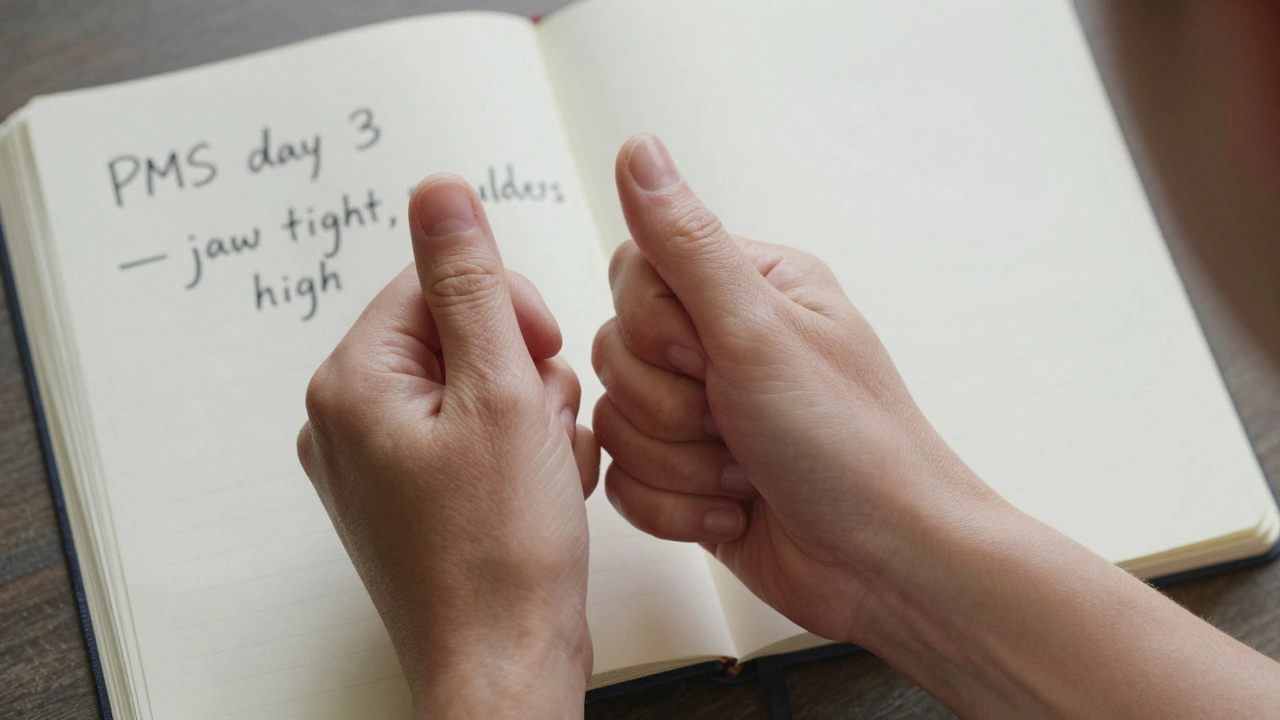
Instead of fighting restlessness, observe it. Keep a simple log after each session:- What time of month are you in?
- Did you sleep poorly the night before?
- Were you emotionally drained before sitting down?
- Where in your body did the restlessness show up most? Shoulders? Feet? Jaw?
After a few weeks, patterns emerge. Maybe you notice restlessness peaks right before your period. Or maybe it spikes after arguing with someone. This isn’t about fixing yourself-it’s about understanding your rhythm. When you see the pattern, you stop blaming yourself. You start adjusting.
Short Sessions Are Better Than Perfect Ones
You don’t need 20 minutes. You need 3. And sometimes, 60 seconds counts.Try this: Set a timer for 90 seconds. Sit comfortably. Breathe normally. When your mind wanders (and it will), say to yourself: "Okay, I’m restless." Then go back to breathing. No judgment. No correction. Just acknowledgment.
That’s it. That’s the whole practice. You’re not trying to become calm. You’re learning to be with what’s already here. Over time, those 90 seconds build tolerance. They build trust. You start to realize: restlessness isn’t the enemy. It’s just data.
When Restlessness Is a Signal, Not a Problem
Sometimes, the body uses restlessness to say: "I need to move. I need to cry. I need to be heard." If you’re feeling intense physical agitation-shaking, tingling, heat-don’t force stillness. Get up. Walk outside. Stretch. Write in a journal for five minutes. Let the emotion move through you.One woman I know started crying every time she sat to meditate. She thought she was doing it wrong. Then she realized: she hadn’t cried since her mom passed away two years earlier. Meditation wasn’t causing the tears-it was creating space for them. She stopped trying to "meditate better" and started letting herself feel.
Restlessness can be a doorway, not a barrier.
What Helps Most: Real Stories From Real Women
- Maya, 34, mother of two: "I used to feel guilty every time I got up during meditation. Now I do seated breathing while folding laundry. My hands are busy, my mind is quiet. It counts." - Lena, 47, perimenopausal: "I meditate in the shower. The water on my skin, the steam-it’s my anchor. I don’t need silence. I need sensation." - Chloe, 29, nurse: "I lie on the floor for two minutes after my shift ends. No music. No phone. Just breathing. It’s not meditation. It’s survival."There’s no one right way. Only what works for you.
Final Thought: You’re Not Broken
Restlessness during meditation doesn’t mean you’re failing. It means you’re human. It means you’ve carried a lot. And it means you’re showing up-even when it’s hard.Progress isn’t measured in stillness. It’s measured in willingness. In showing up again tomorrow. In choosing to sit, even when your legs itch. In whispering, "I’m here," even when your mind is screaming otherwise.
That’s the practice. Not perfection. Just presence.
Why do I feel more restless during meditation than before I started?
Meditation doesn’t create restlessness-it reveals it. Before, you were probably distracted by work, scrolling, or noise. Now, in stillness, you finally notice how tense your body is or how busy your mind has been. This isn’t a bad sign. It’s the first step toward real change. The goal isn’t to eliminate restlessness, but to stop fighting it.
Is it normal to feel physical sensations like tingling or heat during meditation?
Yes. As your nervous system shifts out of fight-or-flight mode, you may feel tingling, warmth, or even slight shaking. These are signs of energy release, not problems. Don’t move unless it’s painful. Just breathe through it. These sensations usually fade within a few days of consistent practice.
Should I meditate at the same time every day?
Consistency helps, but rigidity hurts. If you’re a night owl and your energy peaks after dinner, meditate then. If you’re a parent who only gets 5 minutes before the kids wake up, that’s enough. The best time is the one you’ll actually do. Your nervous system learns from repetition, not perfection.
Can meditation help with PMS or perimenopausal symptoms?
Yes. Studies show that regular mindfulness practice can reduce irritability, anxiety, and sleep disruption linked to hormonal shifts. It doesn’t stop the hormones, but it changes how your brain responds to them. Women who meditate regularly report feeling more in control during their cycle-not because the symptoms disappear, but because they feel less overwhelmed by them.
What if I fall asleep during meditation?
If you’re tired, you’re tired. Falling asleep isn’t failure-it’s your body asking for rest. Try meditating sitting up, with your back supported. Or meditate after a short walk. If you’re consistently falling asleep, you might need more sleep, not more meditation. Listen to your body. Rest is part of healing.