Recovering From an Eating Disorder: Practical Tools and Real Stories
 Aug, 16 2026
For years, the number on the scale dictated how Maya felt about her day. If it went up, she was a failure. If it stayed the same, she was stagnant. It wasn’t until she hit rock bottom during a routine blood test that the reality of eating disorder recovery is a non-linear process of rebuilding trust with your body and mind, moving beyond restrictive dieting to achieve sustainable physical and psychological health set in. Her doctor didn’t scold her; they just asked why she hadn’t eaten fruit in six months. That question broke the spell. Now, three years later, Maya doesn’t count calories. She listens to hunger cues. But getting there required more than willpower-it required specific, actionable tools.
Recovery isn’t just about food. It’s about dismantling the belief system that equates worth with thinness. For many women, this journey begins in adolescence, fueled by societal pressures and media ideals. The path out is rarely straight. It involves setbacks, emotional eating, and moments where the old voice whispers louder than the new one. Understanding the mechanics of this shift is the first step toward freedom.
The Psychology Behind the Restriction
To fix what’s broken, you have to understand how it broke. An eating disorder often starts as a coping mechanism. When life feels chaotic-whether due to academic pressure, relationship issues, or family dynamics-controlling food intake provides a false sense of order. This creates a cycle where restriction leads to bingeing, which leads to guilt, which leads to further restriction. Breaking this loop requires addressing the underlying anxiety, not just the symptoms.
Cognitive Behavioral Therapy (CBT) is a structured psychotherapy approach that helps individuals identify and change negative thought patterns and behaviors, widely recognized as a first-line treatment for eating disorders remains the gold standard for treatment. However, therapy alone isn't enough if your daily environment still triggers the disorder. You need to change your relationship with food before you can change your thoughts about it. This means stopping the war against your own biology.
Practical Tools for Daily Life
You don’t need a therapist in your pocket every time you open the fridge. You need practical habits that reinforce safety. Here are four concrete tools that help maintain momentum during the hardest parts of recovery.
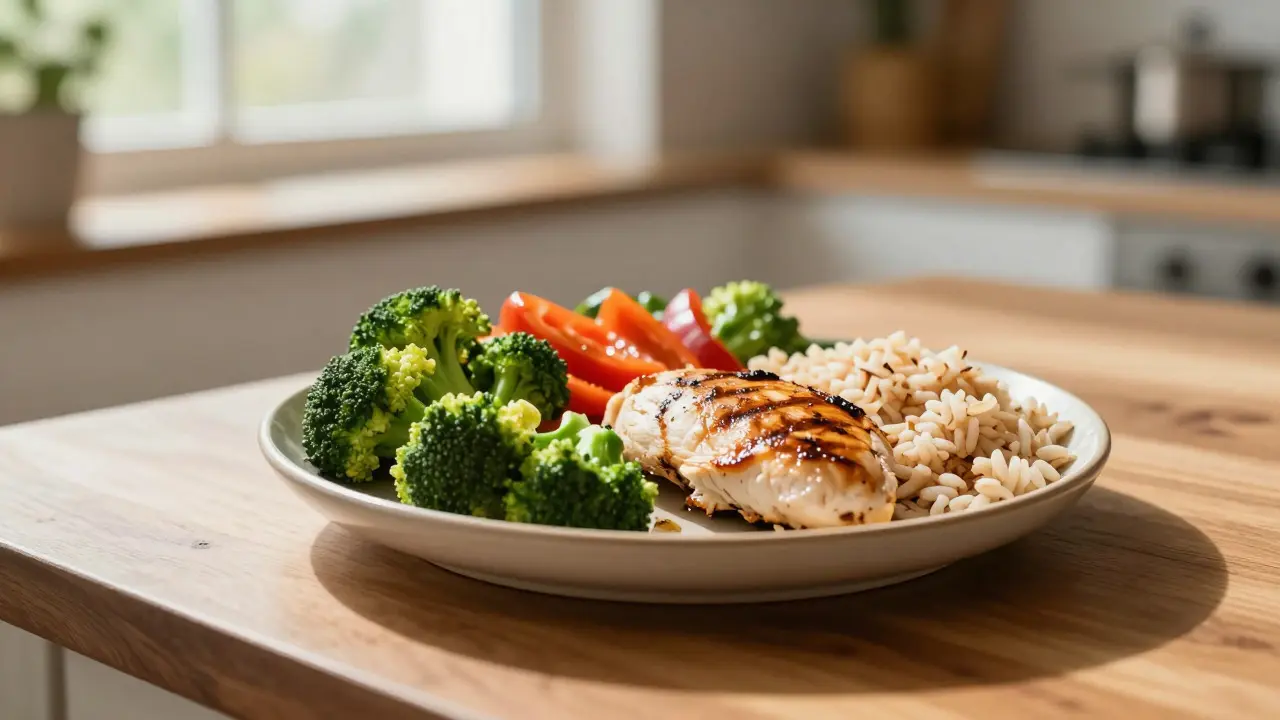
- The Plate Method: Stop measuring portions in grams or cups. Instead, visualize your plate. Fill half with vegetables or fruits, a quarter with lean protein, and a quarter with complex carbohydrates. This simple visual cue removes the decision fatigue associated with portion control. It ensures you get nutrition without the stress of calculation.
- Hunger Scale Check-ins: Use a 1-to-10 scale to rate your hunger before and after meals. A 3 is "hungry," a 5 is "comfortable," and a 8 is "stuffed." The goal is to eat when you’re at a 4 or 5 and stop at a 7 or 8. This retrains your brain to recognize internal signals rather than external rules.
- The 20-Minute Rule: It takes approximately 20 minutes for your brain to register satiety. Slow down. Put your fork down between bites. Drink water. This prevents overeating and allows you to actually enjoy the texture and taste of food, shifting the focus from fuel to experience.
- Journaling Prompts: Keep a brief journal next to your bed. Instead of logging calories, write down one thing your body did for you that day. Did it walk you to work? Did it hug your child? This builds gratitude and shifts the narrative from performance to function.

Building a Supportive Environment
Your environment can either sabotage your progress or accelerate it. If your house is stocked with "diet" foods labeled as good or "junk" foods labeled as bad, you’re fighting a losing battle. Food neutrality is key. Remove labels. Milk is milk. Chocolate is chocolate. Neither is moral; both are nutrients and pleasure.
Talk to your close circle. Tell them you’re working on your relationship with food. Ask them to avoid commenting on your weight or others’ weights. Small phrases like "you look great" can be triggering if they imply you’ve lost weight. Instead, ask for comments on your energy, your smile, or your recent achievements. This subtle shift reduces the social pressure that often fuels disordered eating.
| Aspect | Restrictive Dieting | Intuitive Eating |
|---|---|---|
| Focus | External rules and numbers | Internal hunger and fullness cues |
| Food Labels | Good vs. Bad | Neutral / All Foods Fit |
| Emotional Response | Guilt, shame, anxiety | Trust, satisfaction, calm |
| Long-term Sustainability | Low (often leads to rebound) | High (lifestyle integration) |
Navigating Setbacks Without Shame
Setbacks aren’t failures; they’re data. If you binge on ice cream after a stressful week, don’t punish yourself with a two-day fast. That’s the old pattern talking. Instead, acknowledge the stress. Eat another bowl if you want. Then, ask yourself: What triggered this? Was I lonely? Tired? Overwhelmed? Address the root cause. Maybe you need a break from work. Maybe you need to call a friend. Recovery is messy, and perfection is the enemy of progress.
Many people fear that gaining weight means they’ve failed. In reality, weight fluctuation is normal. Hormones, hydration, muscle mass, and even the time of day affect the number on the scale. Detach your self-worth from that number. Your value is inherent, not conditional on your size. This mindset shift is the cornerstone of lasting body positivity is a social movement and personal practice that advocates for accepting all bodies regardless of shape, size, or appearance, challenging narrow beauty standards.

Maintaining Momentum Long-Term
Recovery doesn’t end when you feel better. It becomes a way of living. To keep the gains, integrate mindfulness into your daily routine. Practice deep breathing when you feel anxious about food. Engage in activities that make you feel strong, not just small. Yoga, swimming, hiking, or dancing-choose movements that celebrate what your body can do, not what it looks like.
Stay connected to resources. Online communities can be helpful, but be cautious of echo chambers. Look for groups that emphasize health over aesthetics. Read books by reputable authors who advocate for intuitive eating and trauma-informed care. Surround yourself with information that empowers you, not shames you. Your journey is unique, and there is no single right way to recover. There is only the way that works for you.
Frequently Asked Questions
How long does eating disorder recovery take?
There is no fixed timeline. Some people see significant improvement in six months, while others take several years. The duration depends on the severity of the disorder, the level of support available, and individual healing pace. Consistency matters more than speed.
Is intuitive eating the same as eating whatever I want?
Not exactly. Intuitive eating involves listening to your body’s signals for hunger and fullness, rather than following strict rules. It encourages variety and balance, meaning you might choose nutrient-dense foods because they satisfy you, not because they are "allowed." It’s about trust, not license.
What should I do if I miss a meal?
Don’t panic. Missing a meal is normal in busy lives. Just eat when you next feel hungry. Avoid making up for it with extreme restriction or bingeing. Treat it as a minor blip, not a catastrophe. Your body is resilient and can handle occasional irregularities.
Do I need professional help to recover?
While some people manage mild disordered eating with self-help strategies, professional guidance is highly recommended, especially for severe cases. A registered dietitian specializing in eating disorders and a licensed therapist can provide personalized support and prevent relapse. They offer accountability and expert insight.
How can I stop obsessing over calories?
Gradually reduce reliance on tracking apps. Start by ignoring calorie counts for one meal a day, then expand to a whole day. Focus on how the food makes you feel physically and emotionally. Replace the question "How many calories is this?" with "Am I hungry? Will this satisfy me?" Over time, the obsession fades as trust grows.