Invest in Yourself: Courses, Coaching, and What Actually Pays Off for Women
 Jan, 9 2026
Women are told to invest in their homes, their kids, their jobs, their relationships. But who’s telling them to invest in themselves? Not enough people. And yet, the most reliable return on investment you’ll ever make isn’t in stocks or real estate-it’s in your own growth. Whether it’s a course, a coach, or simply the time you carve out to learn something new, putting money and energy into yourself pays off in ways that ripple through every part of your life.
Why Investing in Yourself Isn’t Selfish
There’s a myth that putting yourself first is selfish. That’s not true. When you grow, you don’t just change your life-you change the people around you. A woman who learns to set boundaries at work becomes less resentful. She’s calmer at home. She stops apologizing for taking up space. That energy doesn’t vanish. It transfers.
Think about it: if you’re exhausted, overwhelmed, and constantly putting others’ needs ahead of yours, you’re not being a hero-you’re running on fumes. Investing in yourself isn’t about luxury. It’s about sustainability. It’s about having the mental bandwidth, emotional resilience, and confidence to show up fully-for your family, your career, your friendships.
What Actually Works: Courses That Deliver Real Results
Not all online courses are created equal. Thousands of them promise transformation but deliver fluff. The ones that actually move the needle for women tend to share three things: they’re practical, they’re rooted in psychology, and they include accountability.
Take communication skills. A course like Nonviolent Communication for Women in Leadership (offered by the Center for Empowered Living) doesn’t just teach you how to speak up. It gives you scripts for tough conversations, role-playing exercises, and a community of women who’ve been there. One participant, a nurse in Seattle, used what she learned to ask for a raise-and got it. She didn’t just learn theory. She practiced until it felt natural.
Another standout is Financial Confidence for Women by the Institute for Women’s Economic Growth. It covers budgeting, investing, negotiating salary, and even how to talk to your partner about money without shame. The course includes downloadable templates, live Q&As, and a private forum. Women who finish it report a 40% increase in financial decision-making confidence within three months, according to their internal survey of 1,200 participants.
The key? These courses don’t just give you information. They give you tools you can use tomorrow.
Coaching: When One-on-One Makes All the Difference
Courses teach you. Coaching transforms you. There’s a reason coaching for women has grown 72% since 2020, according to the International Coaching Federation. It’s not about getting advice. It’s about being held accountable in a space designed for you.
A life coach might help you untangle why you keep saying yes when you want to say no. A career coach might help you map out a path out of a job that drains you-without jumping into something else blindly. A business coach might help a woman who runs a side hustle turn it into a full-time income by identifying her pricing blind spots.
Here’s the thing: coaching works best when it’s specific. Don’t hire a generic life coach who says, “Visualize your goals.” Look for someone who’s worked with women in your situation. A coach who specializes in mothers returning to the workforce. One who understands the unique pressure of being the primary caregiver while trying to build a business. You want someone who’s seen your exact roadblocks before.
And yes, coaching costs money. But compare that to the cost of staying stuck. One woman in Portland spent $2,000 on a six-month coaching program. Six months later, she doubled her freelance income, cut her work hours by 30%, and started saying no to toxic clients. That’s not an expense. That’s a ROI.

What Pays Off? The Data Behind the Choices
Let’s cut through the noise. What actually moves the needle for women investing in themselves? Here’s what the data shows:
- Women who complete even one structured personal development course report a 68% increase in self-efficacy (source: Journal of Women’s Health & Leadership, 2024).
- Those who work with a certified coach for at least three months are 3x more likely to achieve a major personal or professional goal than those who don’t (ICF Global Coaching Survey, 2025).
- Women who invest $500 or more annually in their growth (courses, coaching, books, retreats) are 4x more likely to report high life satisfaction than those who spend nothing (Pew Research Center, 2025).
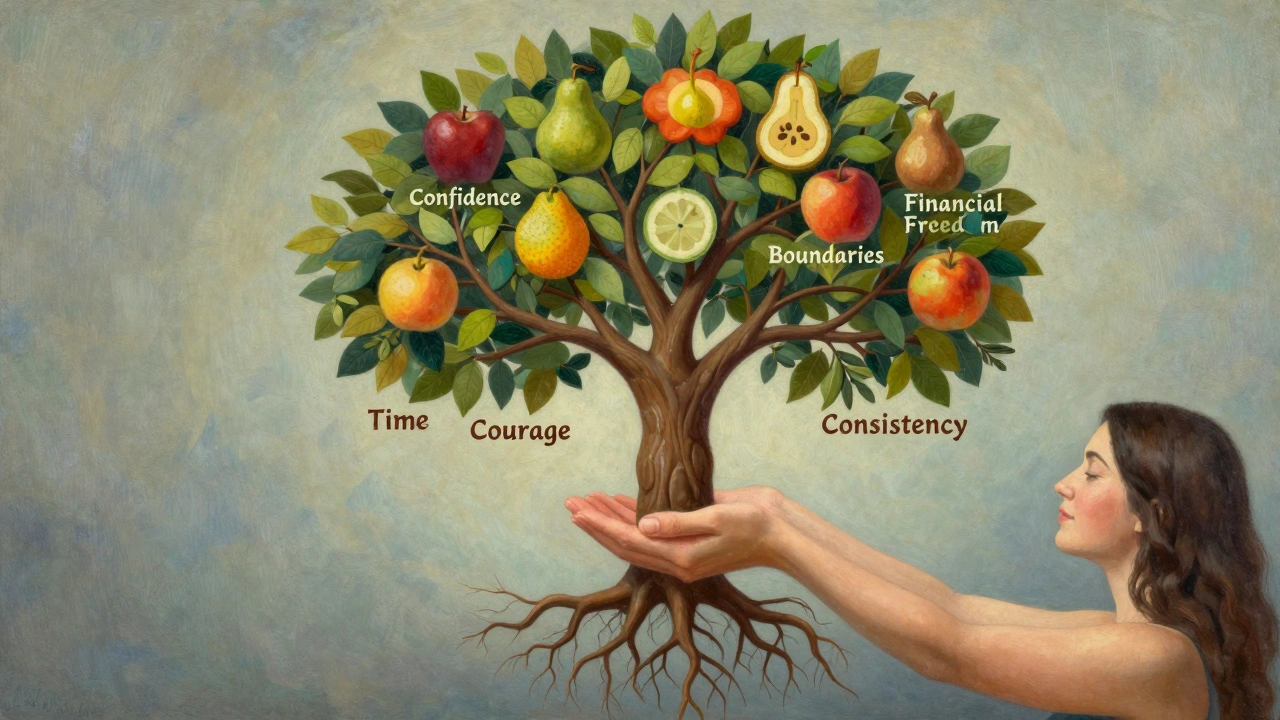
It’s not about how much you spend. It’s about consistency. One $200 course per year, done right, can change your trajectory more than five random $50 webinars.
Where to Start: A Realistic Roadmap
You don’t need to overhaul your life overnight. Start small. Here’s how:
- Identify one area that’s draining you. Is it money? Confidence? Time? Relationships? Pick one.
- Find one resource that speaks directly to it. Not ten. One. A course. A coach. A book with exercises.
- Block out 30 minutes a week for it. Treat it like a doctor’s appointment.
- After four weeks, ask: Did this help me feel more in control? More clear? Less anxious?
- If yes, double down. If no, try something else.
Some women start with journaling prompts from a $15 downloadable guide. Others jump straight into a $1,200 leadership program. Both can work. What matters is alignment. Are you choosing something that feels like growth-or something that feels like another obligation?
Common Mistakes (And How to Avoid Them)
Here’s what goes wrong:
- Buying too many courses at once. You end up with 12 unfinished programs and zero progress.
- Choosing based on hype, not fit. A course that worked for a CEO in Silicon Valley might not help a single mom in rural Ohio.
- Waiting for “the right time.” There’s no perfect moment. There’s only now.
- Feeling guilty for spending money on yourself. That guilt? It’s not yours to carry. It’s cultural.
Stop waiting to be “ready.” You’re not going to feel ready. You’re going to feel nervous. And that’s okay. Growth doesn’t wait for courage. It builds it.
What Comes Next?
Investing in yourself isn’t a one-time purchase. It’s a habit. Like brushing your teeth. Like drinking water. Like sleeping enough. You don’t do it because it’s easy. You do it because it’s necessary.
Next month, try this: Put $50 aside for your growth. Not for a new outfit. Not for a vacation. For a course. A session with a coach. A book that makes you think differently. Then, after six weeks, ask yourself: Did this change how I see myself? Did it change how others treat me?
If the answer is yes-you just made the smartest investment you’ll ever make.
Is it worth spending money on coaching if I’m not sure I’m ready?
Yes. Coaching isn’t for people who have it all figured out. It’s for people who are tired of pretending they do. If you’re even a little curious about what’s holding you back, that’s enough. A good coach will help you uncover the real barriers-not tell you to “just be confident.”
What if I can’t afford coaching or expensive courses?
You don’t need to spend hundreds to start. Look for free or low-cost options: library workshops, nonprofit programs, community college classes, or even YouTube series from certified professionals. Many coaches offer sliding scale rates or payment plans. A $20 journaling workbook, used consistently, can be more valuable than a $500 course you never open.
How do I know if a course or coach is legit?
Check for specifics. Do they share real client stories (with permission)? Do they explain their method, not just their results? Are they certified by a recognized body like the International Coaching Federation or a university-affiliated program? Avoid anyone who promises overnight transformation or uses vague language like “energy work” without clear steps.
Can I invest in myself without spending money?
Absolutely. Reading books from the library, joining free online communities, practicing daily reflection, and setting boundaries with people who drain you are all forms of self-investment. Money helps, but time and attention matter more. The most powerful investment you can make is the decision to prioritize your growth-even if it’s just 15 minutes a day.
What’s the difference between a course and coaching?
A course teaches you information. Coaching helps you apply it. Think of a course as learning how to drive. Coaching is having a driving instructor in the passenger seat, helping you navigate traffic, deal with anxiety, and adjust your route when things go off track. You need both-but coaching is where real change happens.