Going Back to Work as a Mom: Logistics, Emotions, and Support
 Jan, 13 2026
Coming back to work after having a baby isn’t just about changing outfits or relearning Zoom meetings. It’s a quiet storm of logistics, emotions, and gut-level decisions that no one warns you about. You packed the breast milk, set the alarm for 5:15 a.m., and still cried in the parking lot because your baby didn’t wave when you left. You’re not broken. You’re human.
The Logistics: It’s a Full-Time Job Before You Even Clock In
Before you even sit at your desk, you’ve already managed five moving parts: the pump schedule, the daycare drop-off window, the lunch prep, the laundry pile that’s now three days deep, and the 11th-hour diaper change while your toddler tries to climb the bookshelf. There’s no manual for this. You’re making it up as you go, often while sleep-deprived.
Most working moms in the U.S. return to work within 12 weeks of giving birth, according to CDC data from 2025. But what gets left out? The hidden labor. That’s the 47 minutes you spend searching for the right bottle nipple, the 20 texts to your partner about whether the baby ate enough, and the mental load of remembering who’s picking up groceries on Tuesday.
Here’s what actually works for real moms:
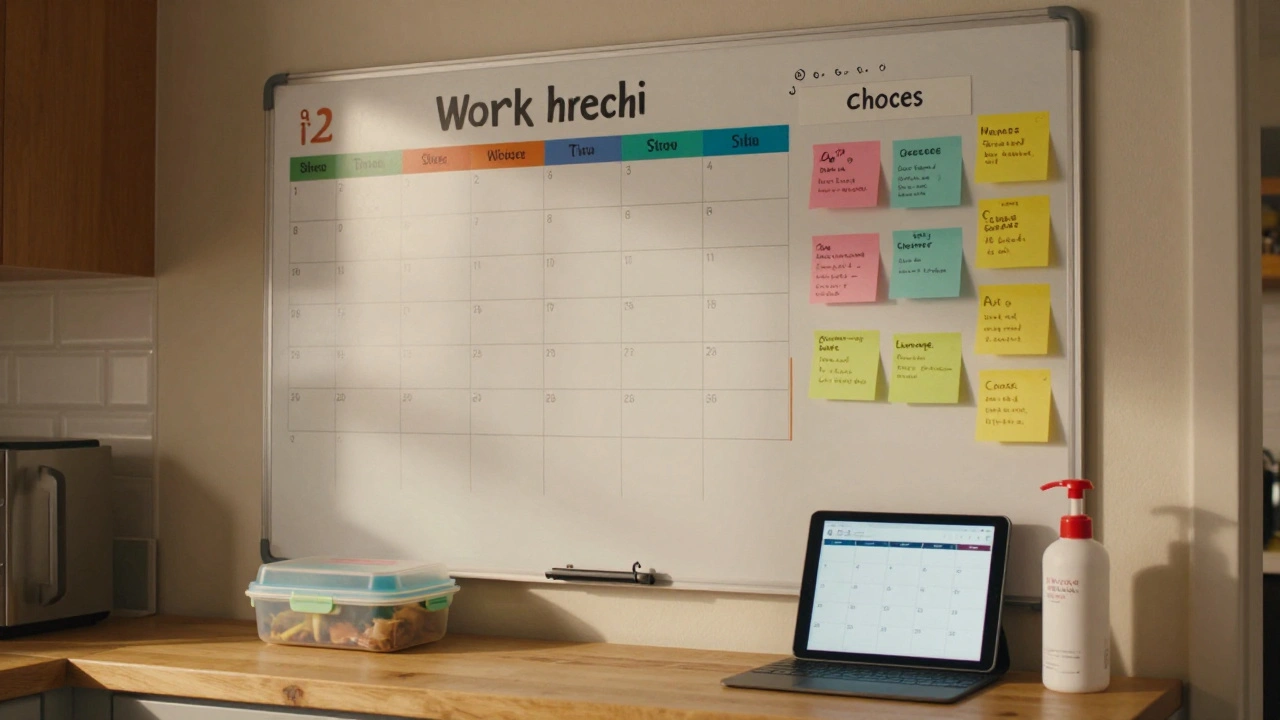
- Set up a family command center - a whiteboard or app where everyone writes down their tasks. No more guessing who’s responsible for the pediatrician appointment.
- Batch your errands. One trip to the pharmacy, grocery store, and dry cleaner saves three separate drives.
- Use a shared digital calendar with color-coded blocks for work, childcare, and personal time. If it’s not on the calendar, it doesn’t exist.
The Emotions: Guilt Isn’t Real - But It’s Everywhere
You feel guilty when you leave. You feel guilty when you don’t leave. You feel guilty when you’re tired. You feel guilty when you’re energized. Guilt is the invisible fourth shift.
But here’s the truth: guilt is not a signal that you’re doing something wrong. It’s a signal that you care deeply. That’s not a flaw - it’s a feature of being a mom.
One mom I talked to in Portland, a nurse who went back to work at 8 weeks, said she cried every morning for six months. Not because she didn’t love her job - but because she missed her baby’s first smile, first crawl, first babble. She didn’t stop working. She just started recording 30-second voice notes to play for her daughter at night. Now, her daughter knows her mom’s voice even when she’s not there.
Don’t try to fix the guilt. Just name it. Say out loud: “I’m feeling guilty because I’m trying to do two big things at once. That’s hard, and that’s okay.”
Support Isn’t a Luxury - It’s the Foundation
Most moms think they need more time. But what they really need is better support. And support doesn’t always come from your partner, your parents, or your employer - though those help.
Real support looks like:
- A colleague who covers your Zoom meeting when your toddler has a fever.
- A friend who shows up with a frozen meal and says, “I don’t need you to talk. I just need you to eat.”
- A workplace policy that lets you leave early one day a week to attend a doctor’s appointment without using PTO.
Companies that support working moms don’t just offer parental leave. They offer flexible hours, on-site childcare subsidies, and managers trained to have honest conversations about burnout. In 2025, a survey of 5,000 working mothers found that those with access to flexible scheduling were 68% less likely to quit their jobs in the first year after returning.
And if your workplace doesn’t offer that? Start small. Ask for one change. “Can I work from home one day a week?” “Can we try a 4-day compressed workweek for three months?” You’d be surprised how often the answer is yes - especially if you frame it as a pilot, not a demand.
Your Identity Isn’t Lost - It’s Expanding
When you had your baby, you didn’t lose your career self. You added a new layer. You’re not “just a mom” or “just a professional.” You’re both. And that’s not messy - it’s powerful.
Think of it like a muscle. The more you use both parts of yourself - the caregiver and the contributor - the stronger they both become. A mom who returns to work often finds she’s more focused, more creative, and more patient. Why? Because she’s no longer trying to be perfect. She’s trying to be present.
One woman I know, a software engineer, started coding during naptime. She built an app that helps other moms track pump sessions and diaper changes. Now it’s used by over 12,000 families. She didn’t go back to work to escape motherhood. She went back to work to expand it.
What No One Tells You: The First Month Is the Hardest - And It Gets Better
There’s a curve. The first four weeks back are brutal. You’re tired. You’re overwhelmed. You’re not sure if you’re doing anything right. That’s normal.
By week six, things start to settle. The baby’s schedule becomes predictable. You learn which meetings can be skipped. You figure out which clothes fit and which ones don’t. You stop apologizing for leaving early.
By three months, you’re not just surviving. You’re adapting. You’ve built routines. You’ve found your rhythm. You might even start to like this version of yourself - the one who can juggle, prioritize, and still show up for her child.

You’re Not Alone - Even When It Feels Like It
Every working mom thinks she’s the only one struggling. But that’s the lie we tell ourselves. In reality, 86% of moms who return to work after childbirth report feeling emotionally isolated in the first three months, according to a 2025 study by the National Institute of Family Health.
So reach out. Text another mom. Say: “I’m having a rough day. Can I vent?” You don’t need advice. You just need to be heard.
Join a local group. Look for “Working Moms of Portland” on Facebook. Attend a coffee meetup at the library. You don’t have to be perfect. You just have to show up.
Final Thought: You’re Already Doing It Right
You didn’t need a checklist. You didn’t need a course. You didn’t need permission. You showed up. You tried. You failed. You tried again. That’s all it takes.
There’s no such thing as a perfect return to work. There’s only your version - messy, real, and entirely yours.
How long should I wait before going back to work after having a baby?
There’s no universal timeline. The CDC says most U.S. moms return within 12 weeks, but that’s an average - not a rule. Some return earlier due to financial needs. Others wait six months or longer. What matters is your physical recovery, your emotional readiness, and your support system - not a calendar date.
What if my employer doesn’t offer flexible hours?
Start by asking. Frame it as a trial: “Could we test a flexible schedule for 60 days?” Many employers are open if you show how it helps productivity. If they say no, look for companies that do offer flexibility - your next job might be the one that finally gets it right.
How do I handle guilt when I’m at work and think about my baby?
Guilt is normal, but it’s not a guide. When it shows up, pause. Breathe. Ask yourself: “Am I doing harm right now?” If the answer is no - then you’re not failing. You’re balancing. Keep a note on your phone with one thing your child did that day. Read it when guilt creeps in.
Can I still breastfeed if I go back to work?
Yes - and many moms do. The key is planning: invest in a good double electric pump, find a private space at work (even if it’s a closet), and schedule pumping breaks like meetings. The FDA and CDC both confirm that breast milk can be safely stored for up to 4 days in the fridge and 6 months in the freezer. You’ve got this.
What if my partner isn’t helping with childcare?
Start with a conversation, not a list. Say: “I feel overwhelmed. I need your help, not just because it’s fair, but because I need to be able to show up at work without burning out.” If that doesn’t work, try a chore chart with clear, non-negotiable tasks. If it still doesn’t change? Seek support - a counselor, a mom’s group, even a trusted friend. You don’t have to carry this alone.